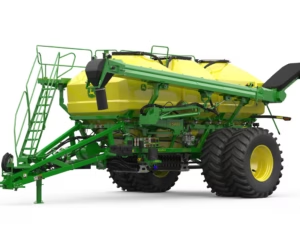
John Deere trailed seeders for sowing
Crates for sown with precision
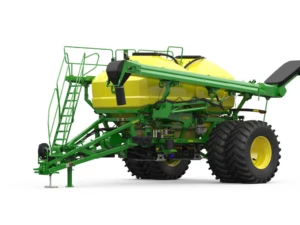
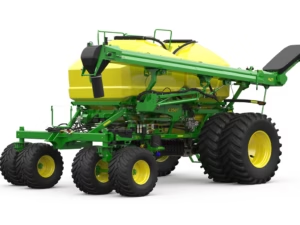
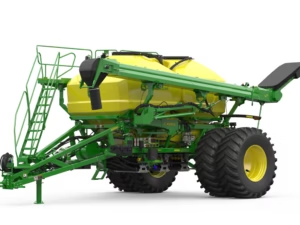
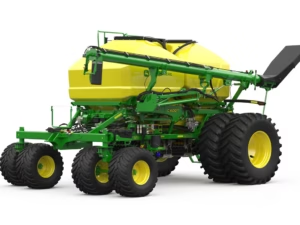
John Deere trailed seeders are designed for the storage, dosing and feeding of the seeders with seeds and fertilizers. These pneumatic equipment complete the direct seeding systems, contributing to the controlled distribution of materials and reducing refueling interruptions.
The range available through IPSO includes the John Deere models C350 and C500, alongside the C400 variants, with capacities ranging between approximately 12.3 and 17.6 m³. The Leading and Trailing configurations allow the bunker to be positioned in front of or behind the planter, depending on the compatibility of the assembly and the requirements of the agricultural operation.
The integrated technologies include AccuRate™ electric dosing pumps, EZCal™ calibration system, Functions of ActiveCal™ and the weighing of the tank. These facilitate the control of the distributed quantities, the monitoring of the available materials and the adjustment of the working parameters directly from the cabin, depending on the equipment’s capabilities.
Differences between John Deere models: C350, C400 and C500
Technologies for Dosage and fertilizing the seedbed
Buncăr Leading or Trailing: what is the difference?
John Deere trailed seeders are available in Leading and Trailing configurations, differentiated by the positioning of the equipment within the agricultural complex. The choice of configuration influences the coupling mode, maneuverability, and compatibility between the tractor, the bunkering system, and the planter, being important for organizing field work.
The Leading configuration – before the seeder
It involves placing the bunker between the tractor and the planter. This positioning allows pneumatic feeding of the seeding equipment, but requires checking the compatibility of the coupling systems and the towing requirements. The John Deere C350L, C400L, and C500L models offer different storage capacities, adapted to the need for seeds and fertilizers.
Trailing configuration – after the seeder
It involves positioning the bunker behind the planter, which is towed to the end of the assembly. The John Deere C350T, C400T and C500T variants allow the feeding of compatible seeding systems, and the choice must take into account the total length of the equipment, the space required for maneuvering and the travel conditions between the plots.
Regardless of the configuration, The choice of a John Deere pneumatic hopper must be correlated with the model of the planter, the required capacity and the requirements of the distribution system. The Leading or Trailing positioning does not by itself determine the accuracy of dosing; this is influenced by the integrated technologies, the equipment settings, and the characteristics of the materials used.
How to choose a John Deere bunker for planting?
The capacity of the bunker must be adapted to the volume of seeds and fertilizers required for agricultural work. The John Deere C350, C400 and C500 models offer different storage volumes, and the choice depends on the area being cultivated, the material requirement and the frequency of refueling during seeding.
The positioning of the bunker in the Leading or Trailing configuration must be correlated with the implement and tractor used. The compatibility of the coupling systems, hydraulic requirements, and the length of the assembly influence the equipment choice, being important for maneuverability and the execution of work under appropriate conditions on agricultural fields.
Electric dosing, calibration, and weighing systems contribute to the management of seeds and fertilizers during seeding. The AccuRate™, EZCal™ and ActiveCal™ technologies allow for control of distribution parameters, facilitating the adaptation of the feeding to the requirements of the work and monitoring the quantities of materials used in the field.
Trailed towed lorries available via IPSO
Frequently asked questions about John Deere tracked dumpers