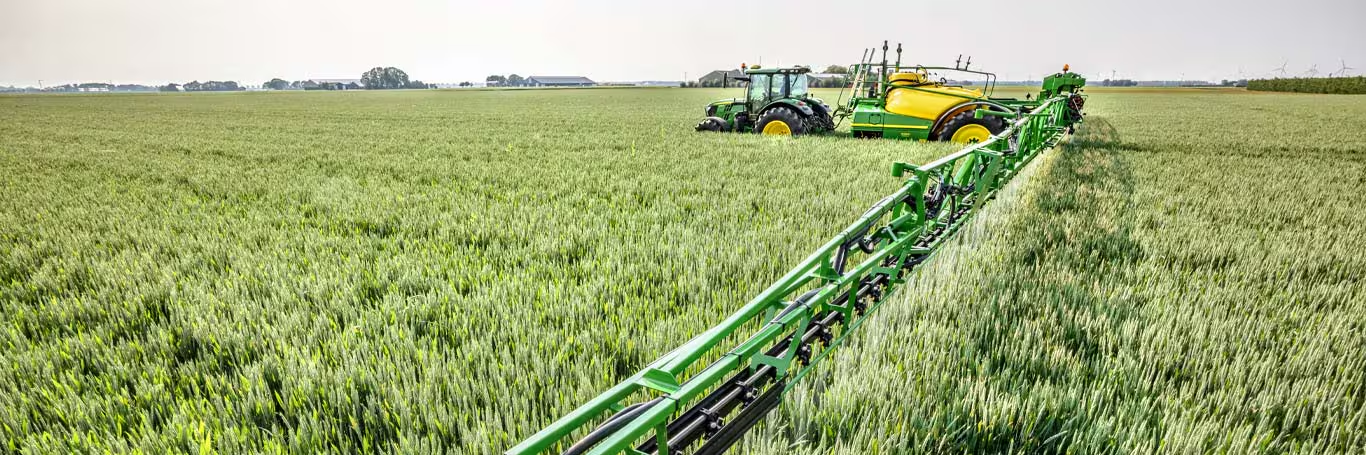
John Deere R900i series sprayers
Treated herbicide machines John Deere R900i ccombines a large-capacity tank with the system PowrSpray™ for solution management and application control. The range includes the models R944i, R952i, R962i and R975i, With nominal volumes ranging from 4,400 to 7,500 liters and ramps from 24 to 40 meters, depending on the configuration.
Choose the equipment in relation to the available tractor, the areas to be treated and the feeding organization. The functions for the nozzle control with a nozzle, the track control and the facility cleaning complete the configuration according to the farm’s requirements.
Autonomy and management of the solution on large areas
A large-capacity tank allows for extended work between feedings, at the same volume of solution applied per hectare. To capitalize on this autonomy, the preparation time of the solution, access to water, and distances between plots also matter.
R900i Series It allows the choice of the appropriate capacity without losing sight of the mass of the loaded assembly, the compatibility with the tractor and the soil conditions.
Separate circuits for filling and spraying
PowrSpray™ It uses two dedicated pump circuits: one for filling the tank and one for spraying. The system allows filling at up to 1,200 l/min and offers spray pump variants of 750 l/min at 3 bar or up to 1,000 l/min depending on the equipment.
Direct rate control adapts the flow to speed variations and section switching. The agitation and rinsing functions complete the solution management during the work.
Order nozzle with nozzle for Limiting overlaps
In compatible configurations, individual control allows the nozzles to be stopped above already treated areas. The function is useful at the ends of plots, on irregular contours and where crossings intersect.
Thorns at 25 cm for working with the lowered ramp
The option of spacing the nozzles at 25 cm allows the use of a reduced height of the chute, with the nozzles and spray angles corresponding. The height is determined according to the nozzle manufacturer’s recommendations, to maintain the correct overlap of the jets and the uniformity of the coverage.
The selection of the cabin doors with TwinSelect
TwinSelect allows switching between two nozzles from the cabin, in compatible configurations. The function simplifies the adjustment of the spray to the requirements of the job, but the choice of nozzles and pressure must be correlated with the product used, the volume of application and the size of the droplets required for the treatment.
Preparation of the solution by transfer closed
With compatible equipment, the direct transfer from the container reduces the open handling of the products and the operator’s contact with them. Check with IPSO the compatibility of the installation, adapters and containers used on the farm.
Control the dose and the position of the ramp
The maintenance of the application volume must be complemented by the control of the rail position. Depending on the equipment, TerrainControl™ Pro and TerrainCommand™ Pro automatically adjusts its height and position to follow the variations in terrain or crop.
The working speed and the pitch settings adapt to the conditions of the plot and the requirements of the treatment.
John Deere R900i Trailed Sprayers available via IPSO
Control of application with Individual Nozzle Control Pro
In compatible configurations, Individual Nozzle Control Pro It regulates the flow of each nozzle by modulating the width of the pulses. The system adapts the spraying to speed variations and allows compensation in turns within the operating range of the equipment.
Control of flow and droplet size
Pulse adjustment adapts the amount of sprayed water by changing the opening time of the nozzles. This allows the flow rate to be managed without exclusively using pressure variation, supporting droplet size control within the operating range of the selected nozzles.
Adaptation of the flow to the working speed
When the tractor accelerates or decelerates, the system modifies the opening time of the nozzles to maintain the set application volume. The function is useful on slopes and in plots with irregular shapes, where the travel speed can vary.
At lower speeds, the system reduces the opening time of the nozzles to adapt the flow to the surface being covered.
With the increase in speed, the system increases the opening time of the nozzles to maintain the set application volume.
Compensation of the flow in curves
In the curve, the nozzles on the outside of the ramp move faster than those on the inside. The system adjusts the individual flow to limit under-dosing on the outside and over-dosing inside the curve.
Without compensation, the speed differences between the ends of the row can produce variations in the volume applied per hectare.
The compensation adjusts the flow of the nozzles to the local speed of travel, for a more uniform distribution in the curve.
Cleaning the tank and the spraying circuit
The management of the solution continues even after the treatment is completed. The flushing must cover both the reservoir and the pipes and components of the spraying circuit.
The automated functions available simplify the dilution and rinsing operations. The procedure, number of cycles and use of cleaning products are determined according to the machine manual and the instructions of the applied products, in order to limit residues and contamination between treatments.
Întrebări frecvente despre John Deere R900i trailed sprayers